Submerged Aquatic Vegetation (SAV)
Main_Content
Coverage and Habitat Status of SAV in Maryland
The abundance of bay grass in Chesapeake Bay has fluctuated greatly since the Virginia Institute of Marine Science (VIMS) started mapping the resource annually in 1984.
The following is a timeline of events that have affected the growth of bay grasses over the last century.
-
1930s
Eelgrass, the most widely distributed species in the bay, was nearly decimated by “wasting disease” in the early 1930s.
-
1940s
Despite significant increases in bay grass numbers by the 1940s, the introduction of exotic species such as
water chestnut and
Eurasian watermilfoil displaced many native bay grasses.
-
1962
Mute swans reproduced rapidly and began feeding on bay grasses after their introduction in 1962.
-
Late '60s-Early 70s
Large-scale declines in submerged aquatic vegetation in the late 60s and early 70s were attributed to increases in nutrients and sediments to the bay.
-
1972
Tropical Storm Agnes (1972) caused widespread damage to bay grass beds.
-
1978
Tracking of bay grass populations by scientists began in 1978.
-
1984
VIMS started mapping bay grasses with aerial photography in 1984.
-
2002
In 2002, bay grasses reached record high numbers (for the time) with an estimated 85,252 acres of SAV mapped Chesapeake Bay-wide.
-
2011
Hurricane Irene and Tropical Storm Lee (2011) significantly reduced underwater grasses in the upper part of the bay.
-
2015
Underwater grasses reached 53,277 acres in Maryland's portion of the Chesapeake Bay in 2015, the highest abundance ever recorded by the aerial survey.
-
2016
In 2016, underwater grasses increased for the fourth straight year in Maryland’s portion of the Chesapeake Bay, reaching a record of 59,277 acres.
-
2017
Underwater grasses reached 62,357 acres in Maryland's portion of the Chesapeake Bay in 2017, surpassing the 57,000-acre target and achieving a new record for the third consecutive year!
-
2018-2019
Maryland experienced record-high rainfall and stream flows into the Chesapeake Bay in 2018 and 2019. This led to higher levels of nutrient and sediment pollution, poorer water clarity, and record low salinities in many of Maryland’s waterways. Because of these reduced habitat conditions, underwater grass abundance declined in 2018 and again in 2019 to 39,151 acres.
-
2021-2022
Maryland’s waterways experienced a slight (13%) increase in SAV between 2021 and 2022. 39,760 acres of SAV were mapped in Maryland’s waterways in 2022.
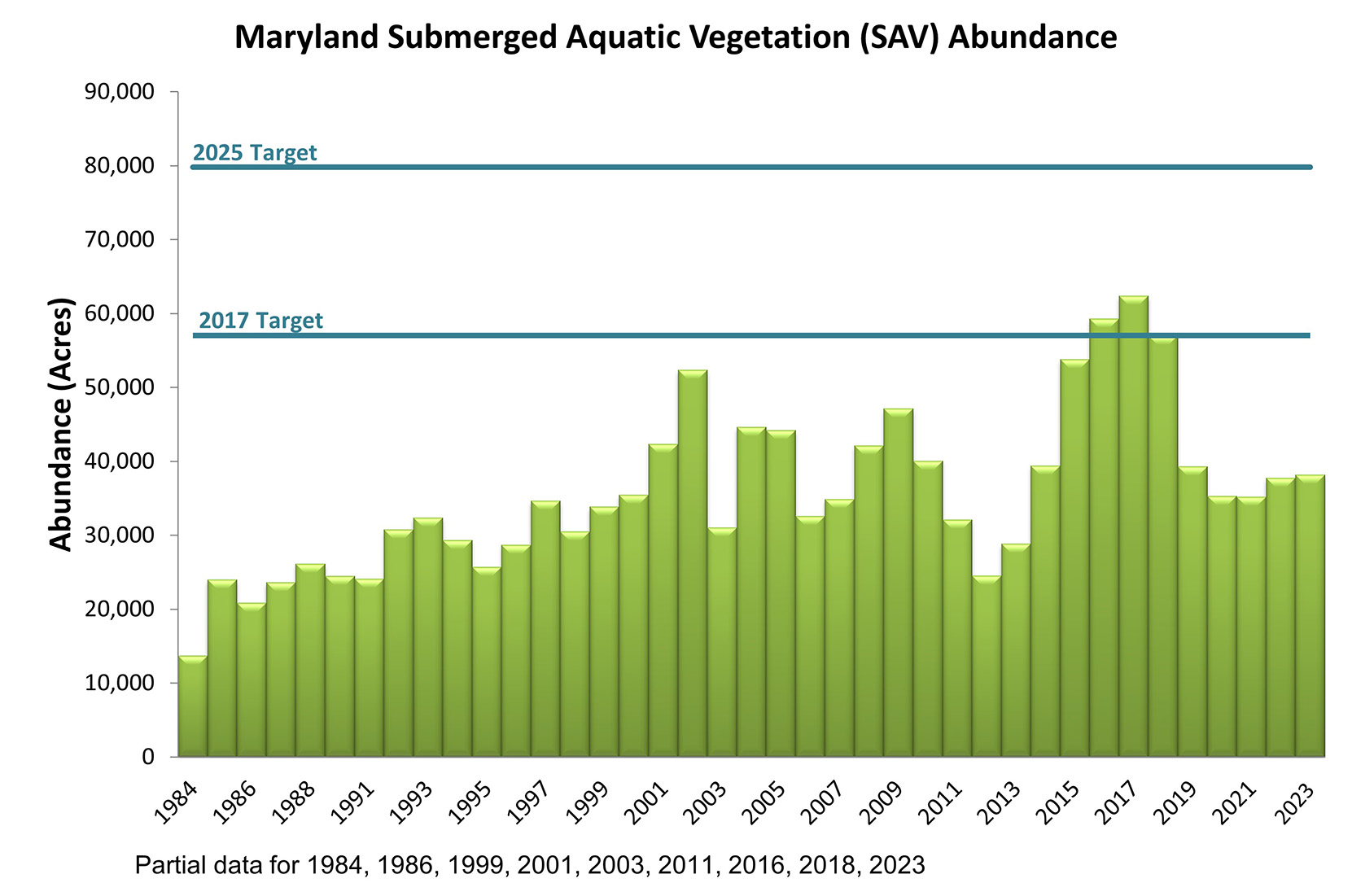
Click Here for Larger Image
View the Baywide 2023 SAV Monitoring Project Report at Virginia Institute of Marine Science
