Brook trout populations face many challenges that threaten their continued occupancy throughout Maryland. Human land development can impact the waters where brook trout live and cause them to become inhospitable to these sensitive fish. It is estimated that brook trout populations will not survive when human land use in a watershed exceeds 18 percent.
Rising Water Temperature
Loss of forest land and riparian buffers and increases in impervious surfaces in watersheds that support brook trout can lead to elevated stream temperatures and degraded water quality. When rain falls directly onto warm paved surfaces, heats up, and flows directly into streams without the natural buffer of trees and plants to slow and cool it down, it can create stressful conditions for trout.

The removal of the riparian buffer of this stream will lead to elevated water temperatures that will be stressful for the resident brook trout population.
Sedimentation
Sediment and silt mobilized from developed land and poorly stabilized soils may settle out in trout redds (nests), which can smother eggs and fry.
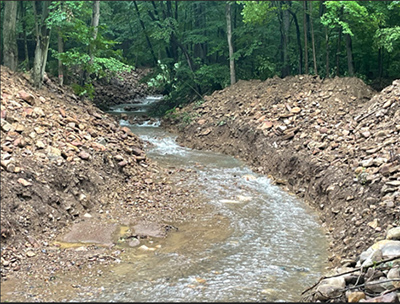
Channelized brook trout stream that has been stripped of aquatic habitat. The banks are not stabilized and will contribute sediment to the stream through erosion.
Fragmentation and Barriers
Brook trout populations can become fragmented through physical, biological, and water quality barriers. Many brook trout populations are isolated in streams and are disconnected from other brook trout populations by downstream barriers. This reduces available habitat and prevents the exchange of genetic material between populations, leading to a loss of genetic diversity. Isolated populations are much more vulnerable to catastrophic events such as drought conditions, high summer temperatures, or the introduction of contaminants. Examples of barriers include dams and perched culverts (physical), stream segments with elevated temperatures or acidic pH (water quality), or competition with other trout species (biological).
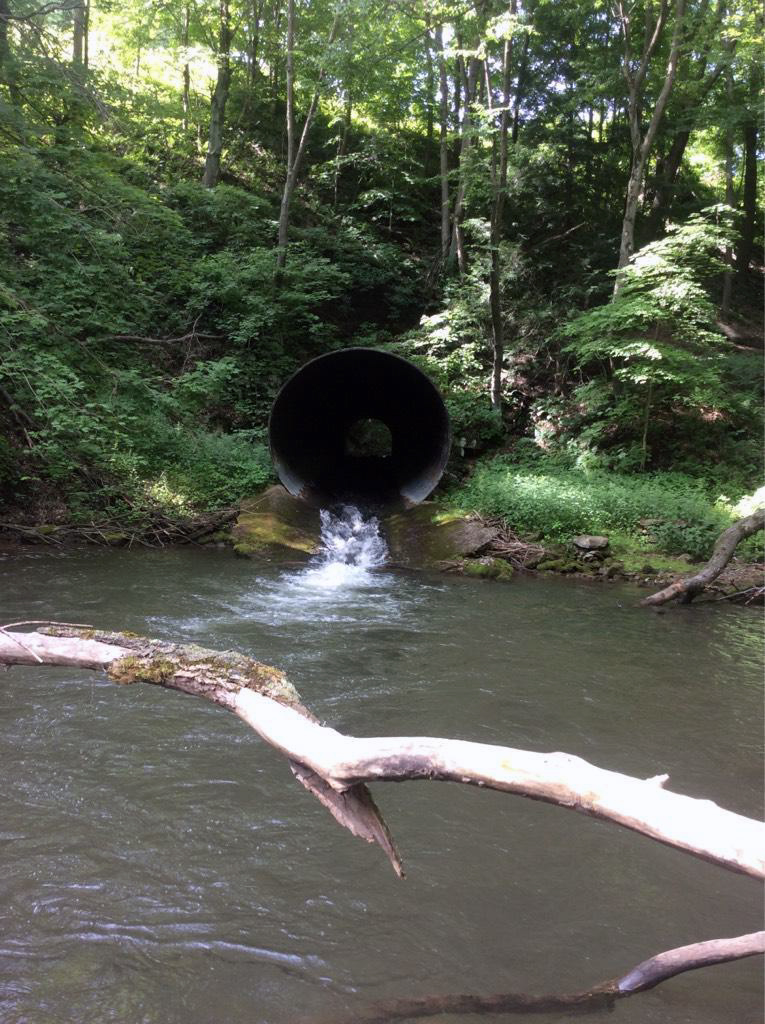
Perched culvert that limits passage in Folly Run for brook trout and other fish species.
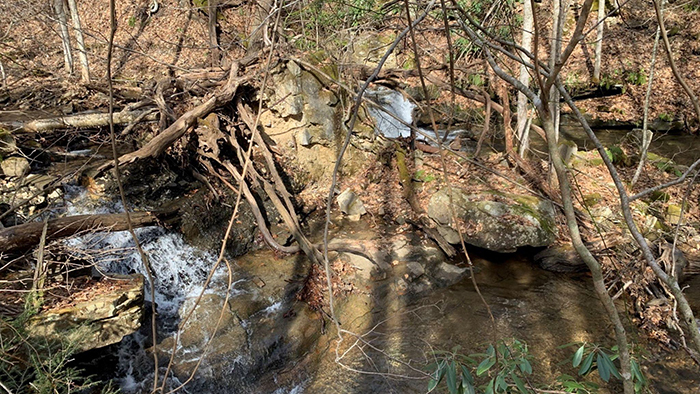
Remnant dam in Wolf Den Run that acts as a barrier for fish passage.
Acidification
In some areas of the state, acidification caused by acid mine drainage or atmospheric deposition may limit brook trout occupancy. The pH of streams affected by acidification may reach levels that are not suitable for supporting aquatic life. These conditions frequently occur near abandoned coal mine sites that continue to discharge contaminated mine water.
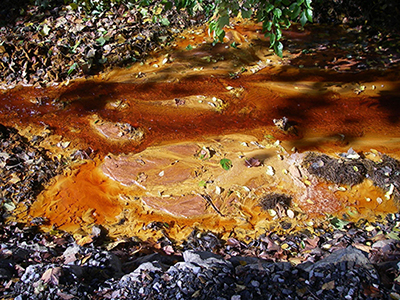
Acid mine drainage seep in a watershed that is pH impaired.
