BACKGROUND:
In 1973 commercial striped bass harvest was at 5 million pounds, but within a decade the commercial harvest decreased to less than two million pounds. An Emergency Striped Bass Research Study suggested that excessive fishing pressure likely decimated the striped bass stock and precipitated the decline. A moratorium on commercial and recreational fishing for striped bass was imposed in 1984 and reopened in 1990 with small seasons and quota limits. When the striped bass stocks began to recover in 1994, Maryland State law capped the number of commercial licensees able to participate in the commercial striped bass fishery at 1,231. As a migratory species, striped bass are monitored by the Atlantic States Marine Fisheries Commission, a regulatory agency designed to coordinate the conservation and management of nearshore fishery resources through a joint program with Atlantic coastal states. State and district quotas are set by the Atlantic States Marine Fisheries Commission based on sampling data and models. Maryland then further divides their portion of the quota among Chesapeake Bay and Atlantic area fisheries. Maryland regulatory regimes attempt to reduce overfishing through various types of restrictions: limits on the amount of time during which fishing can occur, lengths of the season, number of permittees, equipment, the size of the allowable catch, and limits on the amount of fish caught. The adoption of these regulations proved to assist in the restoration of the striped bass population.
In 1995 when the striped bass stock was formally declared recovered, the Atlantic States Marine Fisheries Commission Amendment V was adopted and replaced the original Atlantic States Marine Fisheries Commission fishery management plan and subsequent amendments. The biological target for determining the stock restored has been defined as "the average spawning stock biomass or total weight of sexually mature striped bass females observed between 1960 and 1972. The goal of Amendment V is: "to perpetuate the stock of striped bass so as to allow a commercial and recreational harvest consistent with the long term maintenance of a self-sustaining spawning stock and provide for the restoration and maintenance of essential habitat."
Maryland's commercial striped bass fishery has been operating under new management regulations since the 2014 season. Changes to the management of the commercial striped bass fishery became necessary due to shifts in gear participation, shortened seasons, declining daily and annual catch limits, and new coast wide limits on commercial tag distribution policies passed by the Atlantic States Marine Fisheries Commission. The Individual Transferable Quota (ITQ) system was developed to address the many challenges facing the commercial striped bass fishery.
Commercial striped bass permitted harvesters are issued a percent based share of the total commercial quota called an Individual Transferable Quota (ITQ). This quota is assigned as an amount of pounds that can be harvested throughout the year. Permittees are able to fish their quota during any legal commercial season using any legal fishing gear that their tidal fish license allows. Permittees may also transfer their permits, percent share, and/or annual pound allocation to other licensed harvesters.
Within Maryland, there are two ITQs - BAY and ATL. The BAY ITQ is based on the quota for the Chesapeake Bay. The ATL ITQ is based on the quota for the Atlantic Ocean and coastal bay area.
PERMITS
In order to commercially harvest striped bass, individuals must hold an applicable commercial fishing license and a striped bass permit with share and/or pound allocation. The commercial fishery is currently capped at 1,231 permits.
Each striped bass permit holder is required to declare their intent to harvest striped bass each year in order to remain on the list of eligible permittees. The declaration of intent period takes place from mid-July to mid September. An individual is removed from the striped bass fishery when they fail to declare intent or fails to renew their commercial finfish license and/or permit.
The Department maintains a waiting list for those who possess an applicable commercial fisheries license and would like to obtain a striped bass permit. You can apply to the waiting list by emailing
[email protected]. Applications to the waiting list are added in the order of the date and time the applications are received.
TRANSFERS
Current permit holders can request temporary transfers of permits and/or current year’s pound allocation with their assigned tags by completing the proper transfer application paperwork.
Current permit holders can also request permanent transfers of permits, and/or shares with or without current year’s allocation and tags by completing the proper application paperwork.
Transfer applications can be provided to the Department three different ways:
- If both individuals are FACTS users, allocation transfers can be completed through the FACTS electronic reporting system, this can usually be done in less than 24 hours.
- Transfers can be done via mail, using department supplied forms; or
- Appointments need to be made to submit transfer documents, permit cards, and tags. Please call Casey Maker 1-(410) 279-9369 or Robert LaCava 1-(667) 204-0917 to schedule an appointment.
HELPFUL TIP:
If you are submitting paper transfer forms, please complete this form which will notify Casey or Rob before you submit the paperwork. This may help reduce the time waiting for the transfer to be completed.
Please email [email protected] for assistance or further information.
2026 Striped Bass Transfer Forms: 2027 Striped Bass Transfer Forms: The department maintains
this list of individuals looking to either get or transfer a permit, share, and/or annual pound allocation.
Current Commercial Striped Bass Harvest
In order to not overharvest the striped bass stock, harvest monitoring data is collected using the following methods and then compared for accuracy at the end of the year.
-
Daily electronic or paper log reports from designated check stations (operated by volunteers holding a fish dealer license)
- These reports should be submitted by Check Stations on a weekly basis if using paper or daily using the electronic reporting system called FACTS.
-
Eligible permittee's finfish harvest reports
- Using paper, these reports should be submitted by Licensees/Permittees on a monthly basis.
- Using FACTS, these trip reports should be electronically submitted daily only on the days that eligible Licensees/Permittees are fishing.
- Eligible permittee's paper harvest permit cards.
- These permit cards should be submitted by Permittees after the end of the Striped Bass season.
- For those individuals reporting electronically via FACTS, no paper permit is required.
The harvest estimates illustrated below are based upon daily check station reports received by the department on a weekly basis. They are preliminary figures and may change if check station reports are late. These figures are updated as data becomes available.
Atlantic Coast Fisheries Harvest Chart
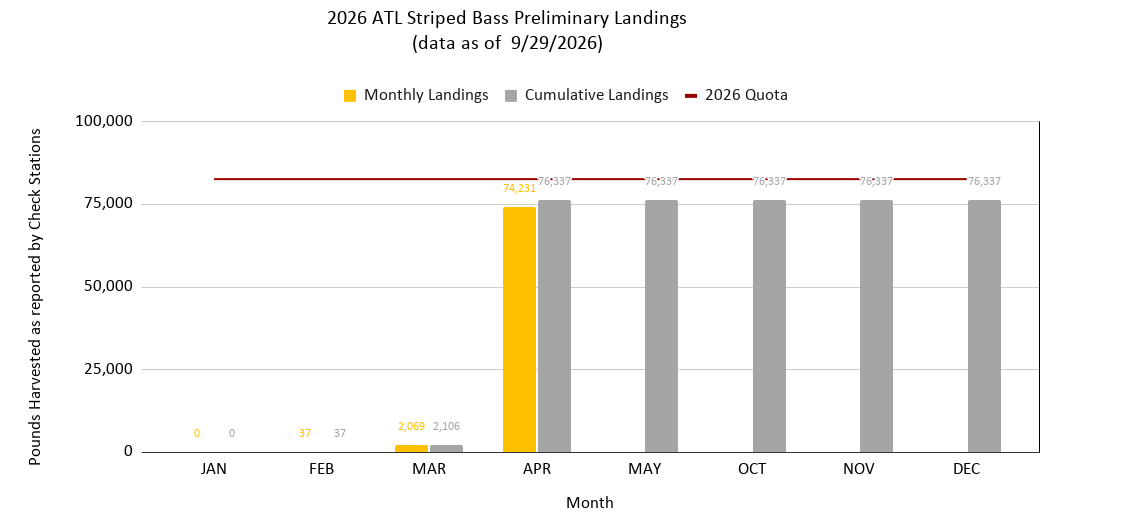
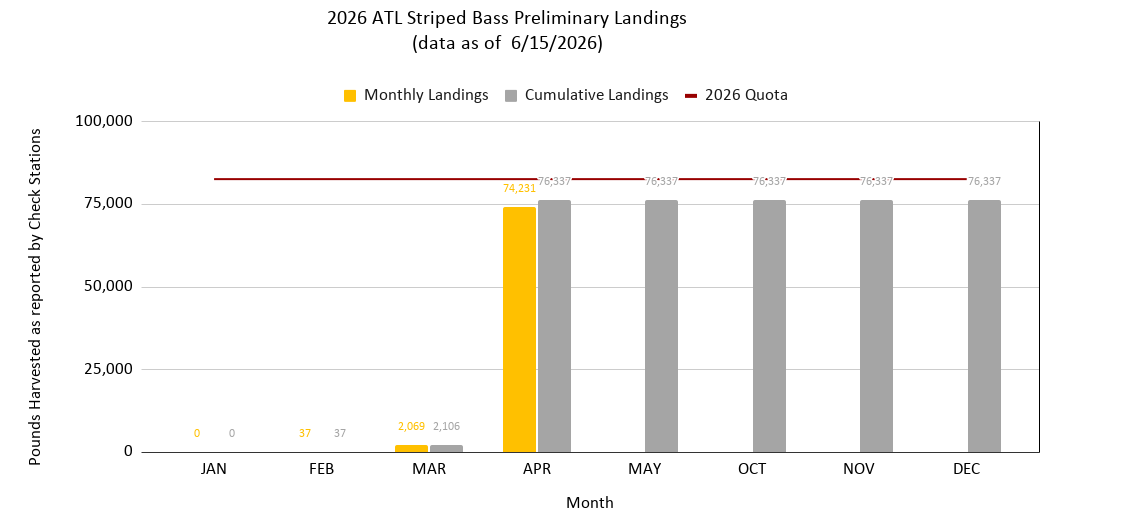
As of September 29, 2026, 76,337 pounds of Striped Bass harvest have been reported
in the Atlantic by Check Stations for the 2026 season. The total allowable catch is 82,644 pounds.
Chesapeake Bay Fisheries Harvest Chart
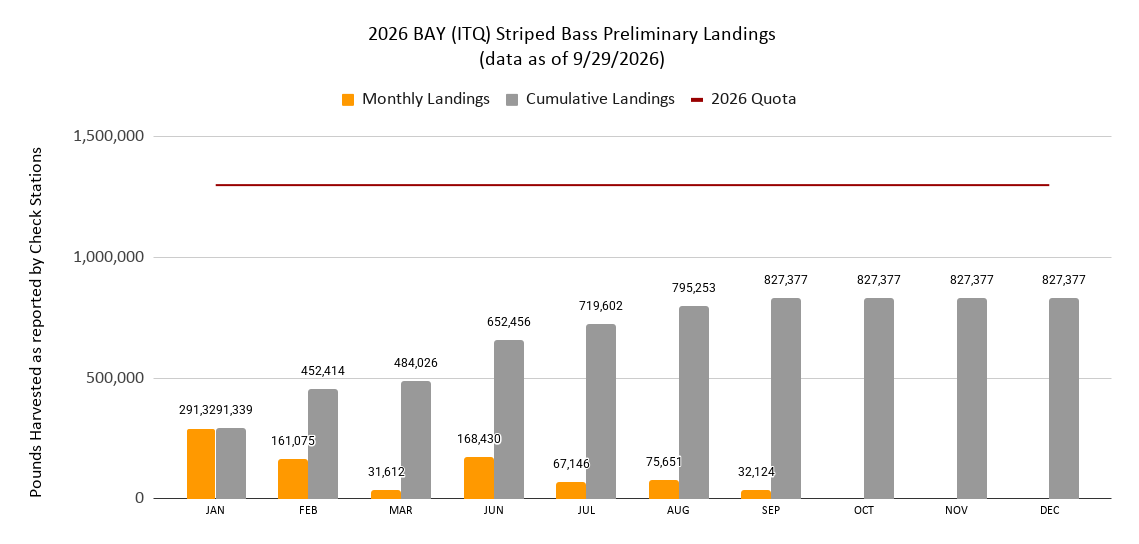
As of September 29, 2026, 827,377 pounds of Striped Bass harvest have been reported
in the Bay by Check Stations for the 2026 season. The total allowable catch is 1,300,306 pounds.
As of January 21, 2026, 1,219,547 pounds of Striped Bass harvest have been reported in the Bay by Check Stations for the 2025 season. The total allowable catch is 1,344,217 pounds. As of January 21, 2026, 76,468 pounds of Striped Bass harvest have been reported in the Bay by Check Stations for the 2025 season. The total allowable catch is 77,017 pounds. This data is considered preliminary and is undergoing QAQC processes currently.
PAST COMMERCIAL STRIPED BASS HARVEST
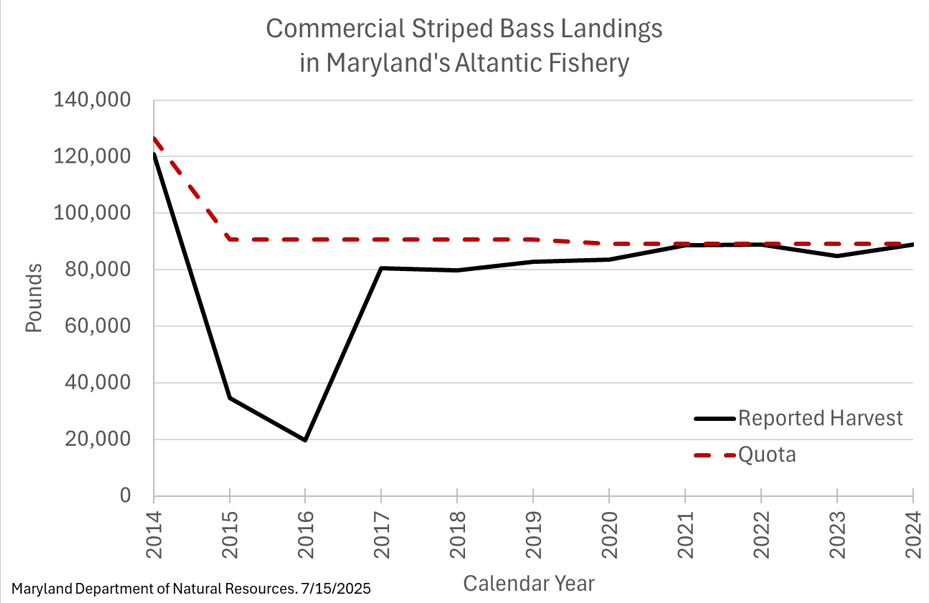
This is updated annually. The last update was 7/15/2025. Data could change in the future as additional harvest reports are submitted to the department. The data shown below could vary from data downloaded from the Atlantic Coastal Cooperative Statistic Program due to differences in confidential rules.
Each year, the Atlantic States Marine Fisheries Commission sets a quota for commercial striped bass harvest. There is a separate quota for the Atlantic fishery and Chesapeake Bay fishery. Commercial harvest is reported by check stations, on striped bass permit cards, and on daily commercial fisheries harvest reports.
Since 2014, reported harvest by the Atlantic fishery has ranged from a minimum of 19 thousand pounds to a maximum of 120 thousand pounds. In 2024, it was 88 thousand pounds.
Since 2014, reported harvest by the Bay fishery has ranged from a minimum of 1.2 million pounds to a maximum of 1.8 million pounds. In 2024, it was 1.3 million pounds.
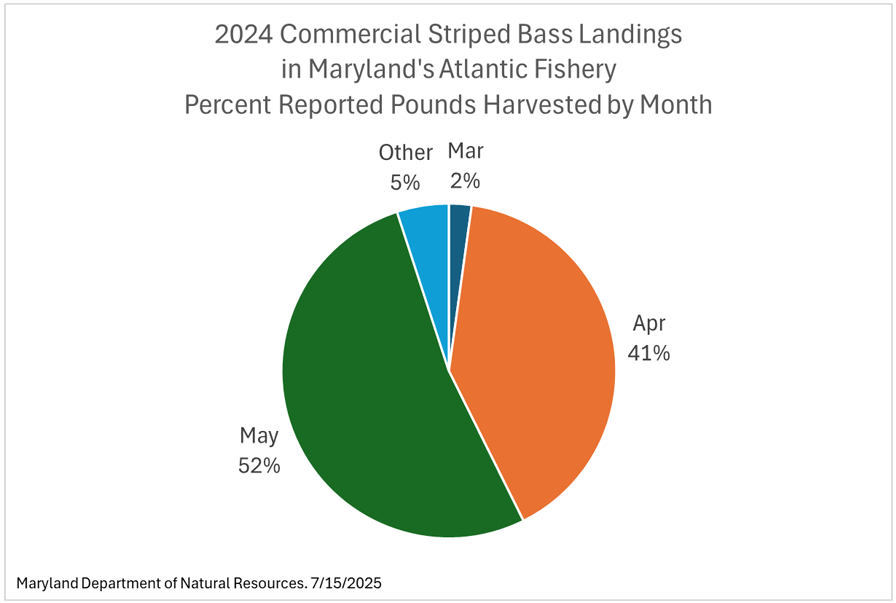
Commercial harvest can occur during various months of the year. In 2024, the majority of the reported harvest by the Atlantic fishery occurred in April and May.
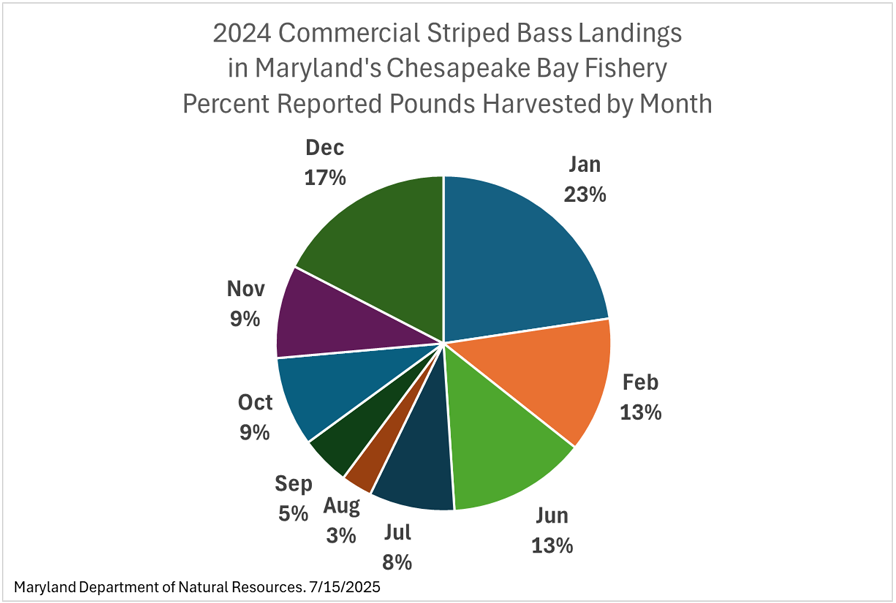
In 2024, the majority of the reported harvest by the Bay fishery occurred in January, February, June and December.
Commercial harvest can occur by various types of gear. In 2024, the Atlantic fishery reported all harvest using gill nets. In 2024, the Bay fishery reported the majority of harvest using gill nets and pound nets.

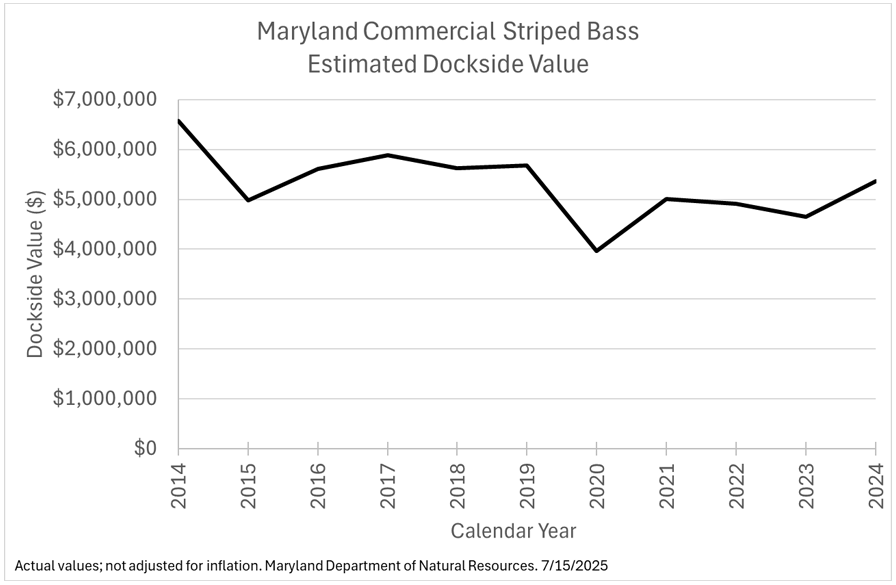
Dockside value represents the value of the harvest when it is landed by the harvester (excludes value added from processing filets, restaurants, shipping, festivals, etc.). Estimated dockside value can be calculated by multiplying the monthly harvest and average monthly price per pound as supplied by seafood dealers.
Since 2014, estimated dockside value (actual values; not adjusted for inflation) for striped bass has ranged from a minimum of $3.96 million to a maximum of $6.57 million. In 2024, estimated dockside value is $5.36 million.
View the
Striped Bass Commercial Harvest Data Table.
Questions or comments should be directed to [email protected].
