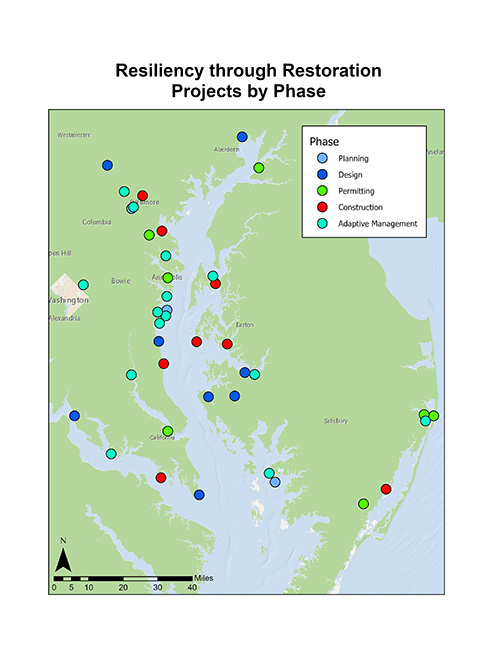
See Map of all Projects
The Resilience through Restoration Initiative supports on-the-ground implementation of restoration projects to help protect communities from erosion, flooding, and other climate change impacts. The goal of this program is to reduce Maryland’s vulnerabilities and enhance resiliency of local communities, economies, and natural resources.
Nature-based restoration techniques can enhance the ability of communities to respond to or recover from storms, flooding and other climate hazards by buffering people and infrastructure. Wetlands, dunes, living shorelines and other green stormwater practices can help communities adapt to changing conditions when used alongside other strategies.
The Resilience through Restoration Initiative enhances community resilience through the following restoration resources and services:
- State and county-level shoreline restoration targeting through the Coastal Resiliency Assessment
- Financial assistance through the Grants Gateway (Outcome 3) to fund design and construction of coastal and stormwater restoration projects in communities and on public lands. Funding is provided by the State of Maryland and the National Oceanic & Atmospheric Administration.
- Technical assistance and guidance for evaluation, design and maintenance of shoreline restoration projects.
- Monitoring and adaptive management of shoreline projects, including development of monitoring protocols and community science trainings.
- Community outreach to discuss and share nature-based resilience strategies.
- Education opportunities for students to participate in shoreline restoration projects and learn about resiliency benefits.
Applying through Grants Gateway
For more details on how to apply please visit our
Grants Gateway page.
Information from the latest solicitation is below:
Important Notice for Applicants:
For the CY2027/FY2028 grant cycle, this funding opportunity is only open to design and permitting proposals. Construction projects are not eligible for funding at this time due to current funding limitations. If additional construction funding becomes available, a separate solicitation may be announced at a later date. Applicants with construction-ready projects are encouraged to contact the designated Contact to discuss future opportunities and project readiness.
When is this proposal due?
December 11, 2026 by 11:59 p.m. EST
When is funding available?
July 1, 2027 - October 1, 2027 depending on fund source and state/federal approvals.
How much funding is available?
Design/permit projects typically cost between $30,000 and $100,000. If your project is above this threshold, please contact the designated Contact to discuss project scope. Permit fees are not eligible. Construction projects are not eligible for CY2027/FY2028 due to funding limitations. Applicants with construction-ready projects are encouraged to contact the designated Contact to discuss future opportunities and project readiness.
Who is eligible to apply?
Local governments and non-profit organizations can submit proposals under this outcome. Please reach out to the outcome contact for more information on non-profit eligibility.
Where can my project be located?
Projects can be located throughout Maryland. Public and private lands are eligible, but projects on private lands must demonstrate a community-wide benefit and provide an access/landowner agreement.
What kind of projects are supported by this funding opportunity?
This funding opportunity supports design/permitting of restoration projects. Design/permit projects are typically completed within 24 months. Projects may include natural and nature-based shoreline restoration, floodplain restoration, beneficial use of dredged material, tidal and nontidal wetland restoration, dune and beach restoration, and green infrastructure such as rain gardens, bioswales, and other green stormwater and restoration practices that provide community and ecosystem benefits by restoring, enhancing, or creating habitat.
Examples of projects may include:
- Design a suite of restoration projects that address coastal and non-coastal flooding and provide community-wide benefits, such as reduced flooding on public bus routes, parks, and schools.
- Design a stormwater practice (i.e. bioretention facility, rain garden, stream restoration, regenerative stormwater conveyance system) that will address rain-induced flooding.
- Design a coastal habitat restoration project that enhances natural features (i.e. wetlands, dunes, forests, floodplains, oyster reefs) while protecting roads, critical infrastructure, or habitat from changing environmental conditions.
- Design a living shoreline or wetland enhancement project that uses local dredged material while protecting public lands that buffer coastal economies.
Who should I contact with application/project questions or ideas?
To discuss project ideas or arrange a site visit, please contact Nicole Carlozo at
[email protected]. Applicants considering project proposals that include beneficial use of dredged material are encouraged to contact Maggie Cavey at
[email protected] to discuss opportunities that may enhance the competitiveness of their proposal.
How is my proposal reviewed and selected for an award?
Eligible projects will:
- Enhance habitat through coastal restoration or nature-based practices. Projects may support design and engineering of restoration practices.
- Address changing environmental conditions. Projects will reduce community flood risk and/or erosion impacts.
- Provide community-wide benefits. Projects will benefit a majority of community members and protect community infrastructure and/or assets.
- Incorporate future conditions data. Projects will address short term (1-10 years) and long term (10+ years) impacts based on the life expectancy of the proposed project. For coastal flooding/erosion projects, consider marsh migration and the 2023 Sea Level Rise Projections for Maryland using the Guidance for Using Maryland’s 2023 Sea Level Rise Projections. For stormwater projects, consider trends in the
Northeast chapter of the Fourth National Climate Assessment, the
Projected Intensity-Duration-Frequency (IDF) Curve Data Tool for the Chesapeake Bay Watershed and Virginia, and/or local flood forecasting.
Competitive projects will:
- Demonstrate readiness and ability to proceed (i.e. work can begin within 6 months).
- Provide community-wide benefits through resilience, water quality, habitat, public access, health, job creation, recreation, or cultural importance to the community .
- Document critical or community infrastructure (i.e. # roads, buildings, parks) benefiting from the project.
- Partner with a local government and/or implement recommendations identified in local plans or assessments (i.e. hazard mitigation plan, nuisance flood plan, green infrastructure plan).
- Restore public lands, allow public access, and serve as a demonstration site.
- Demonstrate community support and engagement opportunities.
- Support technical innovations, such as
beneficial use of dredged material for habitat restoration, shoreline stabilization, beach nourishment, or elevation enhancement of wetlands.
- Provide conceptual-level or greater designs.
- Provide up to 1:1 matching funds or include cost savings measures. Leveraging funds through the Shoreline Erosion Loan Program is highly encouraged, where applicable.
- Shoreline projects will be screened through Maryland’s
Coastal Resiliency Assessment and the
Maryland Coastal Flood Explorer.
What are the required attachments?
-
A Transmittal Letter on official letterhead that is signed by an executive who is authorized to request funding on behalf of the applicant organization.
-
For Projects on Private Lands: Landowner agreement(s) and, if applicable, HOA/Community Land Authorization(s). Templates available on
Grants Gateway site.
-
For Projects in Areas to Be Impacted by Sea Level Rise: Appendix A in the
Guidance for Using Maryland’s 2023 Sea Level Rise Projections report to select a RSLR estimate.
-
For projects that will address flood hazards: WCS encourages applicants to use the
MyCoast: Maryland tool to document current impacts and changes over time.
-
For Non-profit Applicants: Letter of support from a local government representative (i.e. county or town council, town administrator, county planning office, county executive) that addresses how the project supports local efforts to address changing environmental conditions; and, landowner agreement(s) as necessary.
-
Current designs (if applicable)
-
Communication and Engagement Strategy. Template available on
Grants Gateway site.
-
Photographs of current site conditions and impacts from high tide or rain-induced flooding.
-
Complete Budget Table. Template available on
Grants Gateway website
Adaptive Management
Projects that have previously been funded by Maryland’s Resilience through Restoration Fund may be eligible for adaptive management funding. Adaptive Management is an approach to ecological restoration and land management that focuses on learning by doing: where monitoring data are used to inform corrective actions on the current project and increase the likelihood of success of the restoration efforts.
The goal of the Adaptive Management Fund is to address changes in site conditions, lessons learned, or other unforeseen/untimely circumstances for former Resilience through Restoration projects to improve restoration outcomes, rather than addressing impacts that should have been incorporated into the original design or that stem from a lack of routine maintenance. Projects will be prioritized that have social benefits, ecological and water quantity benefits, incorporate long term solutions, and are cost effective. Projects must meet the following eligibility criteria:
- Proposals must be a project previously funded by Maryland’s Resilience through Restoration Fund.
- The project must have a clear rationale for why intervention is needed and why it is outside of the original scope of the project.
- The project will not be considered if still within the grant period and/or within a year of being completed/constructed.
- Project types/BMPs no longer supported by DNR will not be considered.
- Proposals must include past monitoring plans to evaluate if proposed adaptive management objectives will be achieved.
- Long-term maintenance plans must be included.
Adaptive management funds are requested outside of the annual Grants Gateway solicitation. For more information, and link to apply, please reach out to
[email protected] and include the previously funded Resilience through Restoration project name and grant number.
Contact information:
Nicole Carlozo
Chesapeake & Coastal Service
Maryland Department of Natural Resources
Tawes State Office Building E-2
580 Taylor Avenue
Annapolis, Maryland 21401
Phone 410-260-8726
E-Mail:
[email protected]
