Introduction
State Wildlife Action Plans (SWAPs) are important collaborative tools for successful wildlife and habitat conservation nationwide. SWAPs outline strategic conservation approaches for rare and declining wildlife and their habitats in each of the fifty states, the District of Columbia, and the five U.S. territories. The Maryland Department of Natural Resources (MD DNR), Wildlife and Heritage Service (WHS) is responsible for coordinating the development of the Maryland SWAP (or Plan). The overall goal of Maryland’s SWAP is to provide direction and guidance for plant and wildlife conservation efforts in Maryland and, in turn, keep species from becoming listed as endangered; in other words, to keep common species common.
For thousands of years, wildlife including elk, wolves, bison, and heath hens were part of the lives of Native Americans in the land now known as Maryland. Today, these animals are gone from the state; however, more than 20,000 animal and plant species call Maryland home. Over 1,200 of these are known to be rare, uncommon, or declining, while the status of many more is unknown.
Maryland’s plant and wildlife distribution and abundance ultimately depend on the ecological diversity of the state’s habitats. The varied physiographic features, geology and soils, topography, and climate of Maryland support a range of terrestrial and aquatic environments that provide various habitats for plants and wildlife. Maryland’s latitude places it at the southern end of northeastern ecosystems and the northern end of southeastern ecosystems. Maryland’s diverse landscape, wetlands, and waterscape, including the Chesapeake Bay and Atlantic Ocean, support some of the country’s most imperiled and endangered species, such as the seabeach amaranth, Mid-Atlantic beaksedge, dwarf wedgemussel, piping plover, Allegheny woodrat, and rusty-patch bumble bee. A few species in Maryland are found nowhere else in the world. For more examples, please see
Maryland’s rare, threatened, and endangered plant and animal species lists.
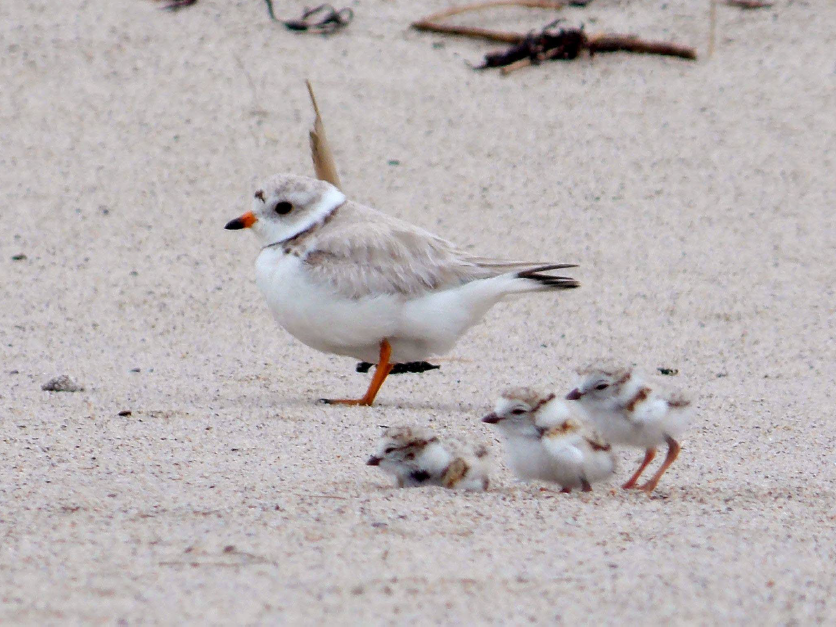
Piping plover
(Charadrius melodus)
Photo credit: Kaiti Titherington, USFWS
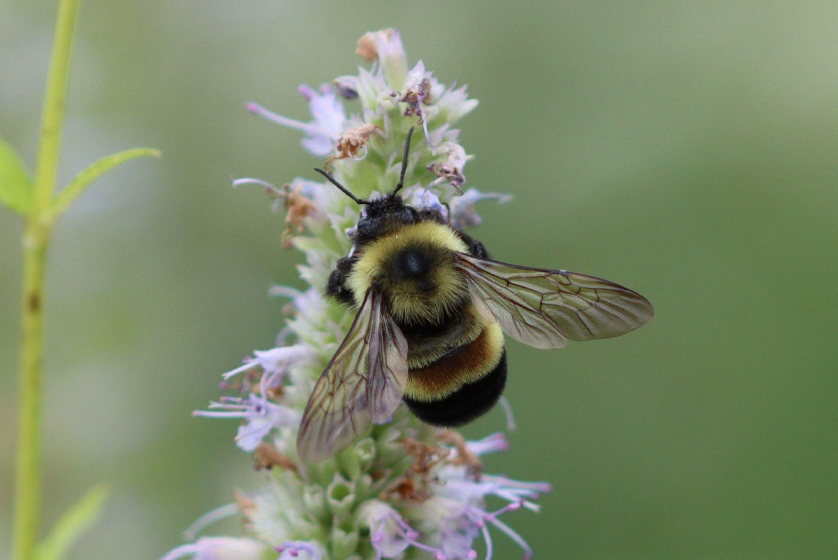
Rusty-patch bumble bee
(Bombus affinis) on anise hyssop
Photo credit: Dawn Marsh, USFWS
Maryland’s State Wildlife Action Plan
The Maryland State Wildlife Action Plan is a statewide, non-regulatory document that provides an essential and effective framework for MD DNR and conservation partners across the state to actively conserve Maryland’s plant and wildlife species and their habitats. It is mandated by the federal government that the SWAP be updated on a 10-year cycle. Maryland’s first plan was known as the 2005 Wildlife Diversity Conservation Plan. The first revision was the
2015 Maryland State Wildlife Action Plan. The most recent revision, which will be Maryland's active SWAP until 2035, was approved and published in August 2026 and can be found here:
2025-2035 Maryland State Wildlife Action Plan.
Collaborative efforts between numerous state, federal, tribal, and local conservation partners first identified Species of Greatest Conservation Need (SGCN), which are those plants and animals, both aquatic and terrestrial, that are at risk or are declining in Maryland. They include threatened and endangered species, as well as many other species whose populations are of concern in our state. The SWAP planning efforts then focused on the Key Wildlife Habitats (KWHs) that those species need for survival, threats and stressors, and the corresponding conservation actions that could be implemented by Maryland’s conservation partners to support both SGCN and their habitats.
The SWAP and its numerous recommended conservation actions all require funding. Development of Maryland’s State Wildlife Action Plan is funded by a federal fund, known as the
State Wildlife Grant Program, or SWG. These funds, distributed through an annual appropriation by the U.S. Congress, are designed to address development and implementation of programs that benefit wildlife, especially Species of Greatest Conservation Need, and their habitats. The SWAP is a requirement for MD DNR to receive these federal SWG funds. The revision of Maryland’s SWAP on at least a 10-year cycle is a condition for the continuation of these federal funds, administered through the U.S. Fish and Wildlife Service. Private tax donations from Maryland’s
Chesapeake Bay and Endangered Species Fund are critical to provide the required match for the federal SWG funds. (For more information on various wildlife program funding sources, click here.)
Here are a few examples of projects in Maryland which have been funded by State Wildlife Grants:
