| Cownose Ray | 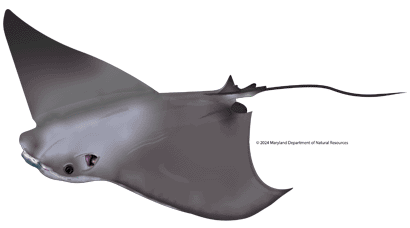 |
Cownose Ray | | Rhinoptera bonasus | (A.K.A. cowfish, cownose stingray)
| Key Distinguishing Markings:
- The body is shaped like a kite with pointed pectoral fins, often called wings.
- The color of the dorsal (top) side of the body ranges from brownish gray to olive, while the ventral (under) side of the body is whitish.
- The head extends from the body in a square shape with an indentation in the center. This bilobed shape gives the ray its signature “cow nose” appearance.
- Males are distinguished from females by the presence of claspers. These appear like a second set of elongated lobes, with one on each side of the tail.
- The cownose ray closely resembles its relative, the Brazilian cownose ray. The only way to tell the species apart is by counting the number of plate-like teeth.
View the Rays and Skates Gallery:
| Distribution:
The cownose ray is one of at least eight living species of stingray in the family Rhinopteridae. The species within this family are each found in distinct geographic regions that span the tropical and temperate warm waters of the Atlantic, Pacific, and Indian oceans. Cownose rays are native to and only found in the western Atlantic Ocean from New England to Argentina, including the Gulf of Mexico and the Caribbean Sea. A recent tracking study observed that the U.S. East Coast population ranges from south of Long Island, New York to Cape Canaveral, Florida. This study is available here to review.
- The U.S. East Coast population undergoes a seasonal long-distance migration along the Atlantic coast. The rays spend the winter off the coast of central Florida. In the spring, schools of rays leave the overwintering grounds and migrate northward. Portions of the adult population disperse into large estuaries along the coast, including the Chesapeake Bay and Maryland Coastal Bays, where they spend the summer. Males leave the estuaries in late summer to forage, followed by females and the young-of-the-year in the fall.
- A 1965 tagging study revealed that the U.S. East Coast population once migrated through the Caribbean to the north coast of Brazil. However, intense fishing pressure has severely reduced cownose rays from much of this southern region. Review the tagging study here.
- A separate population of cownose rays exists in the Gulf of Mexico. This population makes a clockwise migration around the gulf every year.
- Researchers have recently observed a new population of cownose rays in Bermuda. Review the study here.
| Size:
- Cownose rays are typically measured by disc width, which is the width at the widest point of the body.
- At birth, pups are about 16 inches (disc width).
- Adults can grow as large as 40 inches (disc width) and live more than 20 years.
| Habitat:
- Cownose rays are native members of Atlantic coastal ecosystems. They prefer warm waters between 72°F and 82°F. Coastal estuaries are especially important habitats for mating, nurseries for pups, and feeding. Males and females utilize different portions of coastal estuaries throughout the year.
- Cownose rays are a natural part of the coastal food web. They play a central role because they can feed on the bottom (“benthic”) and also swim in the water column (“pelagic”). This makes them benthopegalic creatures.
- Their tooth plates allow cownose rays to crush shelled prey. Available diet data suggest that they feed on a wide range of prey, and prefer thin-shelled bivalves (soft shell, Baltic macoma, and stout razor clams), small crustaceans (mud crabs and amphipods), and benthic worms over hard-shelled bivalves (hard clams, ribbed mussels, and oysters).
- It is difficult for the rays to feed on oyster reefs or clusters. Instead, groups of rays forage in shallow water for buried prey. They excavate soft sediments and leave behind distinctive depressions called feeding pits. Mild disruption within sediment habitats benefits biodiversity. In isolated cases, feeding can also uproot portions of seagrass beds. One study suggests that seagrass patchiness can actually benefit juvenile blue crabs. The study is available here for review.
- Due to the disruption the rays can cause to the bottom, they can be a nuisance to unprotected shellfish aquaculture operations. Additionally, large groups of rays that are actively feeding can impede fishing efforts.
| Spawning:
- Reproductive Mode: Cownose rays exhibit lecithotrophic viviparity. This means that the embryo develops within the mother, but is mostly nourished by the egg’s yolk sac. Later in development, the embryo is nourished by histotroph (uterine milk), which is rich in lipids and proteins. The “milk” is secreted by specialized structures in the uterus called trophonemata. Pups are born live and fully formed.
- Gestation: 11 to 12 months.
- Annual Cycle: The reproductive cycle aligns with long-distance migrations between southern overwintering areas (central coast of Florida) and pupping and mating grounds (Chesapeake Bay and other coastal estuaries).
- Mixed-sex schools, including gravid (pregnant) females with three-quarter term embryos and mature males, arrive in the Chesapeake Bay when spring water temperature reaches 16°C.
- After the spring migration, embryos grow rapidly, increasing almost fourfold in weight between May and July.
- Pups are born between mid-June and early July.
- Closely after pups are born, mating occurs and by August females become gravid with a new embryo.
- By September, the gravid females depart from the estuaries. At this point, the embryos are approximately 20 cm (disc width) and the yolk sacs are depleted.
| Fishing Tips:
- When you catch a cownose ray that you intend to release, the goal is to quickly remove the hook. However, it is good practice to have a device ready to cut the leader or hook as close to the mouth as possible because rays are difficult to handle. They have strong wings and a venomous spine, and they thrash around.
- When wading in coastal waters, it is good practice to do the “stingray shuffle”. As you walk, lightly slide your feet across the bottom rather than taking large steps. This alerts any nearby rays that you are there and will encourage them to swim away and not sting you.
- If fishing for cobia, look for them closely following cownose rays and cast a line behind the ray with a small crab or live fish as bait. Cobia will eat the small invertebrates disturbed by ray foraging.
| Fun Fact:
- A school of rays is called a fever.
- Stingray Point, Virginia is named after an incident between Captain John Smith and a cownose ray. He jumped on one with his sword to capture it and the venomous spine impaled his wrist. His companions described: “the torment was instantly so extreme, that in four hours’ time had so swollen his hand, arm, and shoulder, we all concluded his funeral, and prepared his grave in an island hard by, as himself directed…”
Researchers observed an unusually colored cownose ray in Virginia’s portion of the Chesapeake Bay. The dorsal (top) side of the ray was almost black with a white patch extending across the front of both pectoral fins. Images of the unique coloring are included in this article, available for review here.
- The cownose ray inspired a robot designed to explore the seabed. The article is available for review here.
| | Family: Rhinopteridae (cownose rays) | | Order: Mylobatiformes (stingrays) - Superorder: Euselachii (sharks, rays, and skates) | | Class: Chondrichthyes (cartilaginous fishes) | Rays vs. Skates: Rays and skates are related to sharks and sawfish. They are all part of the Elasmobranch group because their skeletons are made of cartilage rather than bone. Rays and skates are especially easy to confuse, given that they both have diamond-shaped bodies, pectoral fins that resemble wings, and thin tails. Despite these similarities, they have some key differences that can help you tell them apart.
Characteristic
| Rays
| Skates
| Tail
| Usually long and shaped like a whip
| Usually short, thick, and fleshy
| Dorsal Fins
| The tail either lacks a dorsal fin or it is not prominent
| Small and located near the end of the tail
| Pelvic Fin Lobes
| One lobe on each pelvic fin
| Two lobes on each pelvic fin
| Spines vs. Thorns
| Spine or barb is sharp, serrated, and venomous
| Blunt, thorny projections line the tail and back and are not venomous
| Teeth
| Flat and plate-like for crushing prey that have hard shells
| Small and pointy for hunting prey like fish and crustaceans
| Movement
| Flap their wings to swim in the water column
| Undulate their wings to “walk” along the bottom
| Reproduction
| Give birth to fully formed young
| Lay eggs in a pouch that appears black, leathery, and horned
| Species found in Maryland
| More Common:Atlantic stingrayBullnose stingray Cownose ray
Smooth butterfly ray Spiny butterfly ray Southern stingray Less Common: Atlantic torpedo ray Bluntnose stingray Roughtail stingray
| More Common:Clearnose skate Little skate Winter skate
Less Common: Barndoor skate Rosette skate Smooth skate Thorny skate
|
Resources:
For information concerning cownose rays and their management, please contact Simon Brown ( [email protected]) and see the resources below.
|
|

