Many people do not know that it is illegal to disturb the nest of any native bird without a permit.
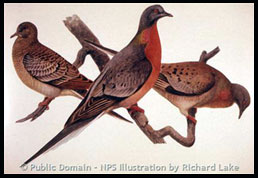 Passenger Pigeons once numbered in the millions. Lack of legal protection led to its extinction before the passage of the Migratory Bird Treaty Act.
Migratory birds in Maryland, including their nests, eggs, and feathers, are protected by a combination of state and federal laws, including the federal Migratory Bird Treaty Act of 1918. Even birds that are not considered "migratory" (like eagles, hawks, and chickadees) are protected. Introduced bird species (like House Sparrows, European Starlings, and Rock Pigeons) and captive-bred game birds (like domestic mallards) are not protected under these laws, although Maryland has specific regulations for captive Mute Swans. A
list of protected birds is available here. Protections for migratory birds and resources to avoid impacts to them will be regularly updated on this webpage.
 Our state bird, the Baltimore Oriole, is protected by the Migratory Bird Treaty Act. Photo: Monica Hawse, 2017 DNR Photo Contest.
Federal and State Protections
The federal Migratory Bird Treaty Act of 1918 is the primary legislation protecting native birds in the United States and one of this country's earliest environmental laws. It prohibits the "taking" of any native birds; "taking" can mean killing a wild bird or possessing parts of a wild bird, including feathers, nests, or eggs. State law also protects wild birds from destruction and possession, including their nests and eggs. It is illegal to keep nests, eggs, and feathers of protected birds, even for "show and tell" educational purposes, or to have road-killed birds in your possession. Exceptions are allowed for hunting game birds and for educational and research purposes, both of which require federal licenses or permits. Permits are seldom granted to individuals, even for research. A state permit may be required in addition to a federal permit - contact the
Wildlife and Heritage Service for more information.
State law provides further protection for birds listed as Endangered, Threatened, and In Need of Conservation through the Nongame and Endangered Species Conservation Act (Annotated Code of Maryland 10-2A-01) and the Code of Maryland Regulations,
COMAR 08.03.08, which lists prohibited activities. Some species receive protection for their nesting areas and habitats through Maryland's Critical Area Law, Forest Conservation Act, wetland protections, and regulations related to Irreplaceable Natural Areas and nesting islands. Maryland's Sustainable Building Act of 2023 protects Maryland's birds from lethal window collisions.
It is illegal to remove or move nests that contain eggs or nestlings, even if:
- they are in an inconvenient location
- the young create piles of poop underneath the nest (like Barn Swallows)
- they build an unsightly nest and drop pigeon and rat remains on the sidewalk in front of an upscale apartment building.
It is illegal to transport, trap, or kill native non-game adult birds like Blue Jays or Northern Mockingbirds without a permit, even if they are harassing birds at nest boxes or feeders.
Do not move a nest, bring eggs inside to keep them warm, incubate abandoned eggs, or bring an injured bird home - even if you are trying to help. Besides being illegal, you will probably do more harm than good. See "Injured or Nuisance Birds" below for what to do when you encounter a baby bird or an injured bird.
The U.S. Fish & Wildlife Service is responsible for administering the Migratory Bird Treaty Act. While the law is not often enforced, penalties are severe - up to six months in jail and a fine of up to $15,000. Equipment used to pursue, hunt, or trap can also be seized. To report violations of the Migratory Bird Treaty Act in Maryland, please contact the U.S. Fish and Wildlife Service’s Northeast Regional Office (Division of Migratory Birds) at 413-253-8643 or the Maryland Natural Resources Police at 800-628-9944. For violations of State laws and regulations, contact the Maryland Natural Resources Police at 800-628-9944.
 A woman wears a "Chanticleer" hat of bird feathers, circa 1912. Photo: George Grantham Bain Collection/Library of Congress.
History
The Migratory Bird Treaty Act has its roots in late nineteenth-century opposition to the millinery trade. The fashions of the 1880s and 1890s favored hats adorned with real feathers and stuffed wild birds. The most popular feathers were the long plumes of egrets and herons. The trade in feathers took a tremendous toll – 200 million wild birds per year by some estimates. Populations of the most hunted species declined precipitously. Then people, including hunters, became concerned about wholesale slaughter of certain species. This prompted passage of the Migratory Bird Treaty Act in 1918. Before this law was passed, hunting of non-game birds was basically unregulated.
Best Practices to Avoid Harm
Migratory birds benefit greatly from the application of established practices to reduce both direct and indirect mortality. Best practices have been developed for industries such as powerlines, wind energy, solar energy, communication towers, and building construction. In addition, recommended actions have been developed for vegetation removal, noise, artificial lighting, human disturbance, and reducing collisions. Following best practices provides a means to comply with federal and state legal protections for migratory birds and supports the conservation of these species in Maryland. Some practices even provide economic benefits. Compiled resources are available at the below links:
Injured or Nuisance Birds
In general, injured native birds should be brought immediately to a licensed, trained wildlife rehabilitator who handles such species. Advice on
what to do if you find a baby bird can be found here. Click
here for a list of Maryland Wildlife Rehabilitators and Wildlife Damage Control Operators. For additional assistance, DNR's Wildlife and Heritage Service and the U.S. Department of Agriculture (USDA) have teamed up to provide you with a phone number to report nuisance, injured, or sick wildlife situations.
To report nuisance, injured, or sick birds, call toll-free in Maryland: 1-877-463-6497.
