The Department of Natural Resources (DNR) Environmental Review Program (ERP) reviews proposed projects and provides recommendations to protect natural resources as part of the State permitting and approval process. ERP reviews are initiated by the permitting agency and are often limited to projects where potential impacts to natural resources have been identified through the agency’s screening process. ERP reviews include the following:
- Wetland and Waterway Permits (tidal and non-tidal) including modification requests and
time-of-year restriction waiver requests
- Landfills (new and expansions)
- Water and Sewer Plans
- Water Appropriations Permits
- Municipal and Industrial Discharge Permits
- Mining and Reclamation Projects
- Dam Safety Projects
- Pesticide General Permits
- Wastewater Treatment Permits (WWTP)
- National Environmental Policy Act Documents
Pre-Application Screening and Mapping Tools
At this time, ERP does not provide formal written fisheries comments for pre-application screening unless a formal DNR response is needed for a grant application or similar circumstance. DNR has developed public self-screening tools that can be used in lieu of a formal DNR review. A screenshot of the Aquatic Resources Pre-Screening Tool results may be submitted with any Joint Permit Application (JPA) package to show coordination with DNR. To perform self-screening, use the following mapping tools:
-
Aquatic Resources: For projects involving aquatic resources, use the
Aquatic Resources Pre-Screening Tool to identify resources that may be present at or near the project location and help determine which time-of-year restrictions may apply.
-
Aquaculture Leases: For projects in tidal waters of the Chesapeake Bay, use the
Aquaculture Siting Tool to determine whether Aquaculture Leases are present.
-
Coldwater Resources: For projects in non-tidal waters, use the
Coldwater Resources Mapping Tool to determine whether trout may be present.
-
Stream Health: For projects where fish species information is needed, use the
Stream Health Index Map.
-
Sensitive Species: For projects located within Sensitive Species Project Review Areas (SSPRAs), request additional screening by the
Wildlife and Heritage Service.
-
DNR Lands: For projects on DNR owned or managed land, submit a project information form. More information is available at:
Maryland Park Service Project Review.
Time-of-Year Restriction Guidelines
Time-of-year restrictions are a science-based tool used to protect natural resources during critical periods in their life cycles. The inclusion of a time-of-year restriction in a permit issued by the Maryland Department of the Environment (MDE) and/or the US Army Corps of Engineers (USACE) are based on recommendations from DNR to protect natural resources during a critical period in their life cycle. These resources are also protected through various Code of Maryland Regulations (COMAR).
Stream Closure Periods
Certain periods of the year are critical for the growth and propagation of aquatic species and the protection of wildlife and habitat. Instream activities are typically not permitted during the following periods:
-
Use I and Use I-P: March 1 to June 15
-
Use III and Use III-P: October 1 to April 30
-
Use IV and Use IV-P: March 1 to May 31
Oysters
For projects located within a Natural Oyster Bar (NOB) or Leased Shellfish Bottom, the following time-of-year restrictions apply:
-
Dredging, use of dredged material, or bank grading: June 1 to September 30 and December 16 through March 14.
- Leased Shellfish Bottom also has specific notification requirements to the leaseholder.
For projects located within 1500 feet (500 yards) of a NOB or Leased Shellfish Bottom, the following time-of year restrictions apply:
-
Hydraulic dredging: June 1 to September 30.
-
Mechanical dredging: June 1 to September 30 and December 16 through March 14.
-
Use of dredged material for beach nourishment or projects involving bank grading: June 1 to September 30 and December 16 through March 14. The time-of-year restriction does not apply to projects with beach nourishment by clean sand.
Submerged Aquatic Vegetation (SAV)
The presence of SAV is determined using annual Virginia Institute of Marine Science (VIMS) survey data from the most recent five-year period or if SAV is documented in an applicant survey. An applicant survey cannot be used to override VIMS survey results. For the purposes of SAV in determining time-of-year restrictions, shoreline stabilization projects include living shorelines, new or replacement bulkheads, revetments, breakwaters, groins, sills, or jetties.
The following time-of-year restrictions apply:
-
Shoreline stabilization/erosion control projects without bank grading: April 15 to October 15 if the project is located in or within 50 feet of an SAV bed.
-
Shoreline stabilization, boat ramp, or miscellaneous filling projects that include any bank grading: April 15 to October 15if the project is located in or within 150 feet (50 yards) of an SAV bed.
-
Dredging or use of dredged material: April 15 to October 15, if the project is located in or within 1500 feet of SAV bed.
Anadromous Fish
The anadromous fish spawning areas are shown on the Aquatic Resources Pre-Screening Tool. The tool includes a layer for yellow perch spawning and a separate layer for striped bass, white perch, American shad, hickory shad, blueback herring, and alewife spawning areas.
The following time-of-year restrictions apply to any sediment or noise generating projects within mapped anadromous fish spawning areas:
-
Areas mapped for yellow perch: February 15 to June 15.
-
Areas not mapped for yellow perch: March 1 to June 15.
Waterfowl
For projects located in Historic Waterfowl Concentration Areas, the time-of-year restriction generally applies from November 15 to March 1 to the following activities:
- Any dredging project;
- Bulkheads over 350 feet;
- Revetments, living shorelines, or marsh restorations over 375 feet;
- Pier construction over 150 feet counting both removal and construction.
For piers, the waterfowl time-of-year restriction does not apply if all dock work, including removal and construction, can be completed in 14 consecutive days.
DNR waives the time-of-year restriction for projects below these thresholds. If a project is subject to time-of-year restrictions for SAV, oysters, and/or spawning fish and would also be subject to the waterfowl time-of-year restriction, the waterfowl time-of-year restriction is waived for that project.
Other Potential Time-of-Year Restrictions
Other, less common resources may also require time-of-year restrictions. DNR may recommend these restrictions following project-specific review. The Sensitive Species Project Review Areas (SSPRA) layer of the Aquatic Resources Pre-screening Tool can be used to determine if a Rare, Threatened, and Endangered Species may exist in the project area. If a project is located within an SSPRA, a review may be requested by
Wildlife and Heritage Service during the project design phase.
Examples of resources that may require additional time-of year restrictions include:
- Tiger Beetles
- Bats
- Map Turtles and Bog Turtles
- Horseshoe Crabs
- Colonial Waterbirds
Multiple Time-of-Year Restrictions
DNR generally prioritizes time-of-year restrictions in the order presented above. If additional resources require time-of-year protections, DNR will coordinate internally to evaluate how to provide necessary protections while allowing an adequate construction window.
Applicants may request DNR attend
MDE JPA Pre-application meetings or request to present at the monthly
Shoreline Project Review Team Meeting or
Joint Evaluation Meeting if discussion of multiple time-of-year restrictions is needed.
Time-of-Year Restriction Waiver Requests
Time-of-year restrictions are included in authorizations issued by MDE based on Maryland regulations and recommendations from the DNR to protect resources during critical periods in their life cycle. DNR generally does not recommend waivers to closure periods unless an emergency situation exists that may jeopardize public health and safety or if DNR determines that impacts to the resource will be insignificant or non-existent.
How to Request a Waiver:
- Download and fully complete the
Time-of-Year Waiver Request Form. Respond to all questions and include a copy of the MDE authorization.
- Once completed, submit the form and Joint Permit Application to MDE via the
Environmental Service Center. MDE will forward the waiver request to DNR for review.
- If a project has been issued a USACE authorization independent from MDE that includes the same TOY restriction or closure period, submit a waiver request directly to the appropriate USACE Regulatory Branch for an independent waiver decision.
- In emergency circumstances and for verbal approval of urgent resource protection measures, contact
MDE directly and then submit the waiver form as soon as possible after the emergency or resource protection urgency has been resolved for documentation and process evaluation.
ERP Contacts
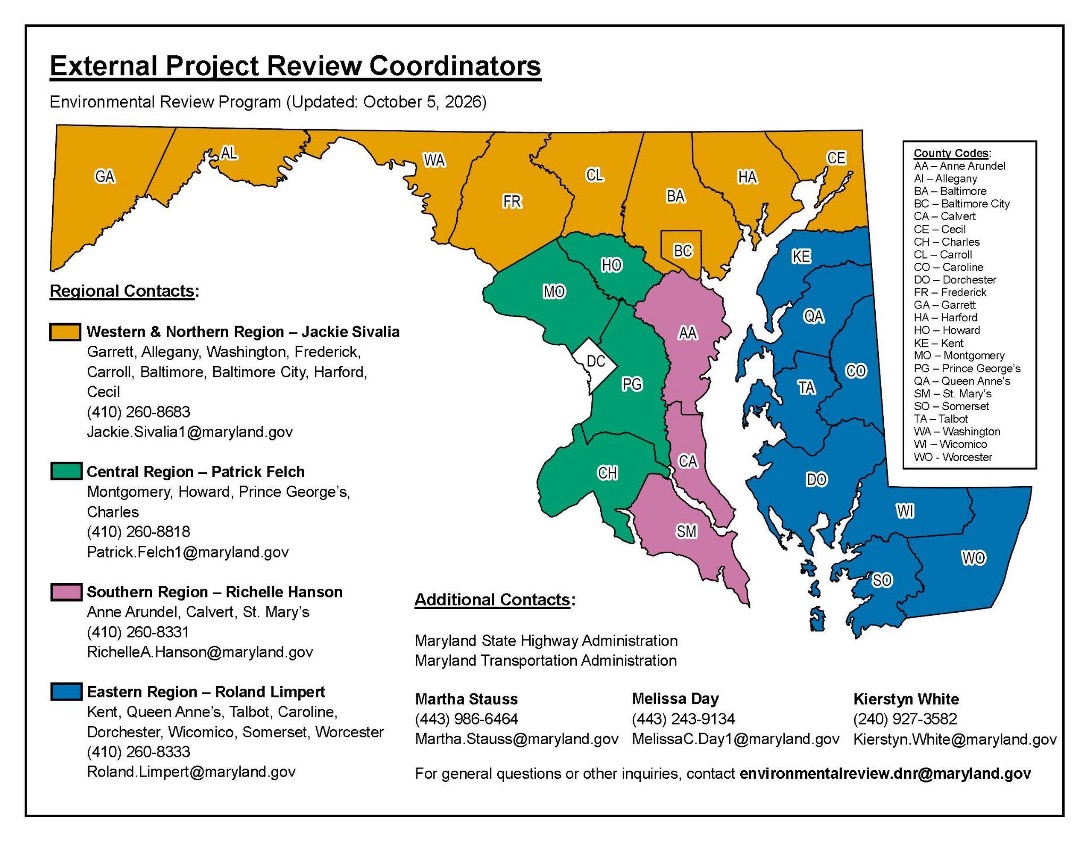
- Western & Northern Region (Garrett, Allegany, Washington, Frederick, Carroll, Baltimore, Baltimore City, Harford, Cecil Counties) – Jackie Sivalia, (410) 260-8683,
[email protected]
- Central Region (Montgomery, Howard, Prince George’s, Charles Counties) – Patrick Felch, (410) 260-8818,
[email protected]
- Southern Region (Anne Arundel, Calvert, St. Mary’s Counties) – Richelle Hanson, (410) 260-8331,
[email protected]
- Eastern Region (Kent, Queen Anne’s, Talbot, Caroline, Dorchester, Wicomico, Somerset, Worcester Counties) – Roland Limpert, (410) 260-8333,
[email protected]
For Maryland State Highway Administration and Maryland Transportation Administration, project contacts are:
For general questions or other inquiries, contact
[email protected].
