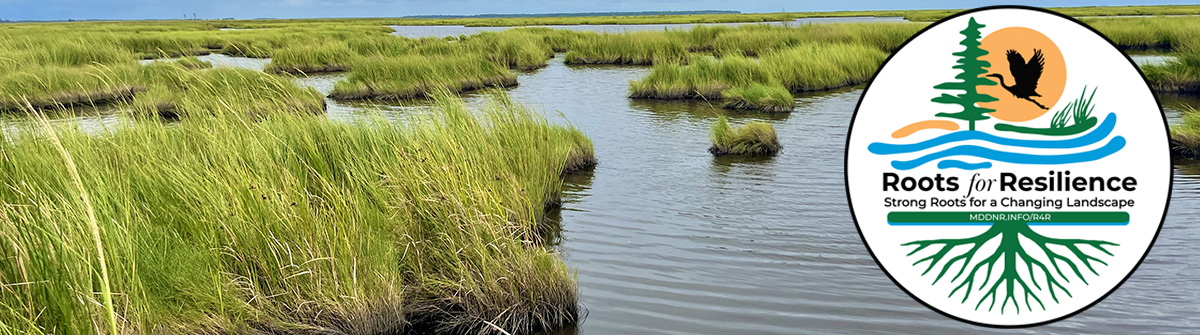
Roots for Resilience is a new initiative designed to help Maryland’s lower Eastern Shore adapt to the challenges of climate change by enhancing nature’s ability to store carbon and buffer climate impacts. Through tree planting, coastal habitat restoration, and community engagement, the initiative strengthens our natural defenses while reducing carbon emissions. Roots for Resilience unites the existing relationships, initiatives, and passions on the lower Shore to nourish roots — ecologically and socially — to preserve this rapidly changing landscape.
At Maryland DNR, we are proud to collaborate with our nonprofit partners to fulfill our commitments in the areas of forestry and wetland restoration. Our key partners include:
- Audubon Mid-Atlantic
- Lower Shore Land Trust
- Eastern Shore Land Conservancy
As part of this initiative, DNR will implement living shorelines for marsh protection, fund wetland restoration activities, and facilitate tidal reconnection. We will also conduct community outreach and leverage existing conservation easements to restore and protect critical habitats, thus mitigating carbon emissions resulting from land conversion and sea level rise.
DNR will collaborate with the Maryland Department of Transportation to expand urban forestry and establish tree cover on land where trees are absent. This work will restore critical habitat, enhance forestry management practices, and expand the state nursery to market locally sourced trees, while promoting community health benefits and protecting forested lands.
Open Solicitations and Information Sessions
What We’re Growing: Nature-Based Solutions for a Resilient Future
Across the lower Eastern Shore, Roots for Resilience focuses on:
- Protecting and restoring high-carbon forest and coastal habitats to maximize climate and community benefits.
- Advancing sustainable forest management to increase carbon capture and preserve biodiversity.
- Building community resilience through outreach, education, and local partnerships.
The areas eligible for Roots for Resilience projects includes the following Maryland counties:
-
Living Shoreline (Marsh Protection) Projects: Dorchester, Somerset, and Wicomico counties.
-
Enhanced Forestry Management and Afforestation Projects: Caroline, Dorchester, Talbot, Somerset, Wicomico, and Worcester counties.
-
Coastal Resilience Management Plans: Dorchester, Somerset, Wicomico, and Worcester counties.
Roots for Resilience will support efforts that reconnect ecosystems and deliver multiple conservation benefits through a suite of strategies to help communities thrive in a changing climate by:
- Planting trees and wetland vegetation to absorb carbon and reduce flooding.
- Restoring tidal marsh habitats to support species like the saltmarsh sparrow and Maryland’s state reptile, the diamondback terrapin.
- Promoting improved forestry practices to protect and regenerate forested lands.
- Implementing living shorelines that protect existing marshes.
- Building regional resilience by working with private landowners to identify adaptation strategies in key marsh migration corridors.
- Outreach and engagement through local liaisons who connect residents to climate resilience efforts.
By investing in trees, marshes, and people, Roots for Resilience is supporting ongoing efforts to build a healthier, more resilient lower Eastern Shore. Together, we’re growing
strong roots for a changing landscape.
For questions or additional information about the initiative, please reach out to
[email protected].
State of Maryland Partners
Nonprofit Partners
A Regional Coalition for Greater Climate Action
Roots for Resilience is a part of the Atlantic Conservation Coalition. Visit the
dashboard to learn more and the
Maryland Department of the Environment overview website.
This project has been funded wholly or in part by the United States Environmental Protection Agency under assistance agreement 3D25824 to the North Carolina Department of Natural and Cultural Resources. The contents of this document do not necessarily reflect the views and policies of the Environmental Protection Agency, nor does the Environmental Protection Agency endorse trade names or recommend the use of commercial products mentioned in this document, as well as any images, video, text, or other content created by generative artificial intelligence tools, nor does any such content necessarily reflect the views and policies of the Environmental Protection Agency.
