Introduction:
The Blue Crab Winter Dredge Survey is an annual, bay-wide field survey conducted by the Maryland Department of Natural Resources (DNR) and the Virginia Institute of Marine Science (VIMS) to sample the blue crab population in the Chesapeake Bay. Data from this collaborative effort are used to determine the number of crabs overwintering in the bay and the percentage of the population that is removed by harvest each year. Management jurisdictions across the Chesapeake Bay rely on the Winter Dredge Survey results to assess the blue crab stock status and guide management decisions.

Methods:
Field Sampling
Each winter, a total of 1,500 sites are sampled throughout the Chesapeake Bay and its tributaries. These randomly-selected sample sites are located in waters deeper than 5 feet and are split into three regions based on habitat type: Lower Bay, Mid-Bay, and Upper Bay/Tributaries. The number of sites in each region is proportional to its area.
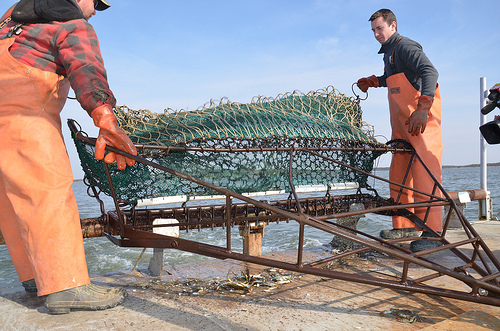
At each sample site, a Virginia crab dredge fit with a half-inch nylon mesh liner is towed along the bottom for one minute at a speed of three knots. Latitude and longitude, measured with a GPS, are recorded at the beginning and end of each tow to determine the distance covered. This distance, multiplied by the width of the dredge, is used to calculate the total area covered by the sample tow, providing an estimate of crab density (# of crabs/area). Depth, water temperature, and salinity are also recorded at each site. All crabs collected are measured from spine to spine across the carapace (carapace width, CW) and weighed. In addition to size, the sex and maturity of each crab are determined before the crabs are returned to the water.
Overwintering Mortality
Unlike crabs in warmer regions, blue crabs in the Chesapeake Bay are susceptible to overwintering mortality, particularly when faced with extreme cold snaps. To estimate the proportion of the population that died from overwintering mortality in a given year, Winter Dredge Survey sites that had high crab densities early in the sampling season are resampled in late winter and the number of dead crabs is recorded.
Gear Efficiency
DNR and VIMS also conduct crossover sampling to estimate relative gear efficiencies between the states’ sampling methods. DNR resamples a selection of sites in Virginia, and VIMS resamples a selection of sites in Maryland. The crab density estimates from the resampling efforts are then compared to the original density estimates to determine how well each vessel is sampling the area.
Estimating Abundance
Sampled crabs are grouped into different categories based on size and maturity to separately estimate the abundance of juveniles, adult females, and adult males. Juvenile crabs (less than 2.4 inches CW) are new recruits that entered the population the previous year and will become part of the fishery in the late summer and fall. Adult crabs (2.4 inches CW or larger) are the mature males and females that will support the fishery throughout the season and have the potential to reproduce in the coming year. Adult female abundance is an important indicator of blue crab stock status.
Abundance is estimated for all crabs (total abundance), juveniles, adult females, and adult males. These abundance estimates provide a snapshot of the Chesapeake Bay population prior to the upcoming crabbing season. To calculate crab abundances in the Chesapeake Bay, the crab density estimates from the Winter Dredge Survey are scaled up to the total area of available blue crab habitat within the bay. The abundance estimates are then adjusted for gear efficiency and overwintering mortality to obtain more accurate bay-wide population estimates.
Learn more about how DNR uses the Winter Dredge Survey data to estimate bay-wide blue crab abundance.
2026 Results:
The total abundance (all males, females, and juveniles) of blue crabs in the Chesapeake Bay increased to 349 million in 2026.
Juvenile abundance increased substantially in 2026 to an estimated 228 million.
Adult male abundance increased slightly to 37 million in 2026.
Estimated adult female abundance declined to 81 million in 2026. Adult female abundance is a key reference point for blue crab fishery management in the Chesapeake Bay. Management aims to have 196 million adult females in the population, but the stock is still considered healthy as long as the abundance is above the threshold of 72.5 million. Although adult female abundance declined in 2026, the estimate is still above the management threshold.
Blue crab abundances for each year of the Winter Dredge Survey are listed below:
Abundance (millions of crabs)
| Year | Juveniles | Adult Males | Adult Females | Total |
|---|
| 1990 | 463 | 197 | 117 | 791 |
| 1991 | 356 | 242 | 227 | 828 |
| 1992 | 105 | 90 | 167 | 367 |
| 1993 | 503 | 179 | 177 | 852 |
| 1994 | 295 | 103 | 102 | 487 |
| 1995 | 300 | 109 | 80 | 487 |
| 1996 | 476 | 59 | 108 | 661 |
| 1997 | 512 | 70 | 93 | 680 |
| 1998 | 166 | 80 | 106 | 353 |
| 1999 | 223 | 31 | 53 | 308 |
| 2000 | 135 | 40 | 93 | 281 |
| 2001 | 156 | 43 | 61 | 254 |
| 2002 | 194 | 65 | 55 | 315 |
| 2003 | 172 | 85 | 84 | 334 |
| 2004 | 143 | 47 | 82 | 270 |
| 2005 | 242 | 46 | 110 | 400 |
| 2006 | 196 | 36 | 85 | 313 |
| 2007 | 112 | 50 | 89 | 251 |
| 2008 | 166 | 37 | 91 | 293 |
| 2009 | 170 | 54 | 162 | 396 |
| 2010 | 348 | 72 | 246 | 663 |
| 2011 | 204 | 64 | 191 | 452 |
| 2012 | 581 | 82 | 95 | 765 |
| 2013 | 111 | 42 | 147 | 300 |
| 2014 | 199 | 29 | 69 | 297 |
| 2015 | 269 | 44 | 101 | 411 |
| 2016 | 271 | 91 | 194 | 553 |
| 2017 | 125 | 76 | 254 | 455 |
| 2018 | 167 | 59 | 147 | 372 |
| 2019 | 324 | 80 | 191 | 594 |
| 2020 | 185 | 79 | 141 | 405 |
| 2021 | 86 | 39 | 158 | 282 |
| 2022 | 101 | 28 | 97 | 227 |
| 2023 | 116 | 55 | 152 | 323 |
| 2024 | 138 | 46 | 133 | 317 |
| 2025 | 103 | 26 | 108 | 238 |
| 2026 | 228 | 37 | 81 | 349 |
Download the density estimates from the Winter Dredge Survey here.
